Imports
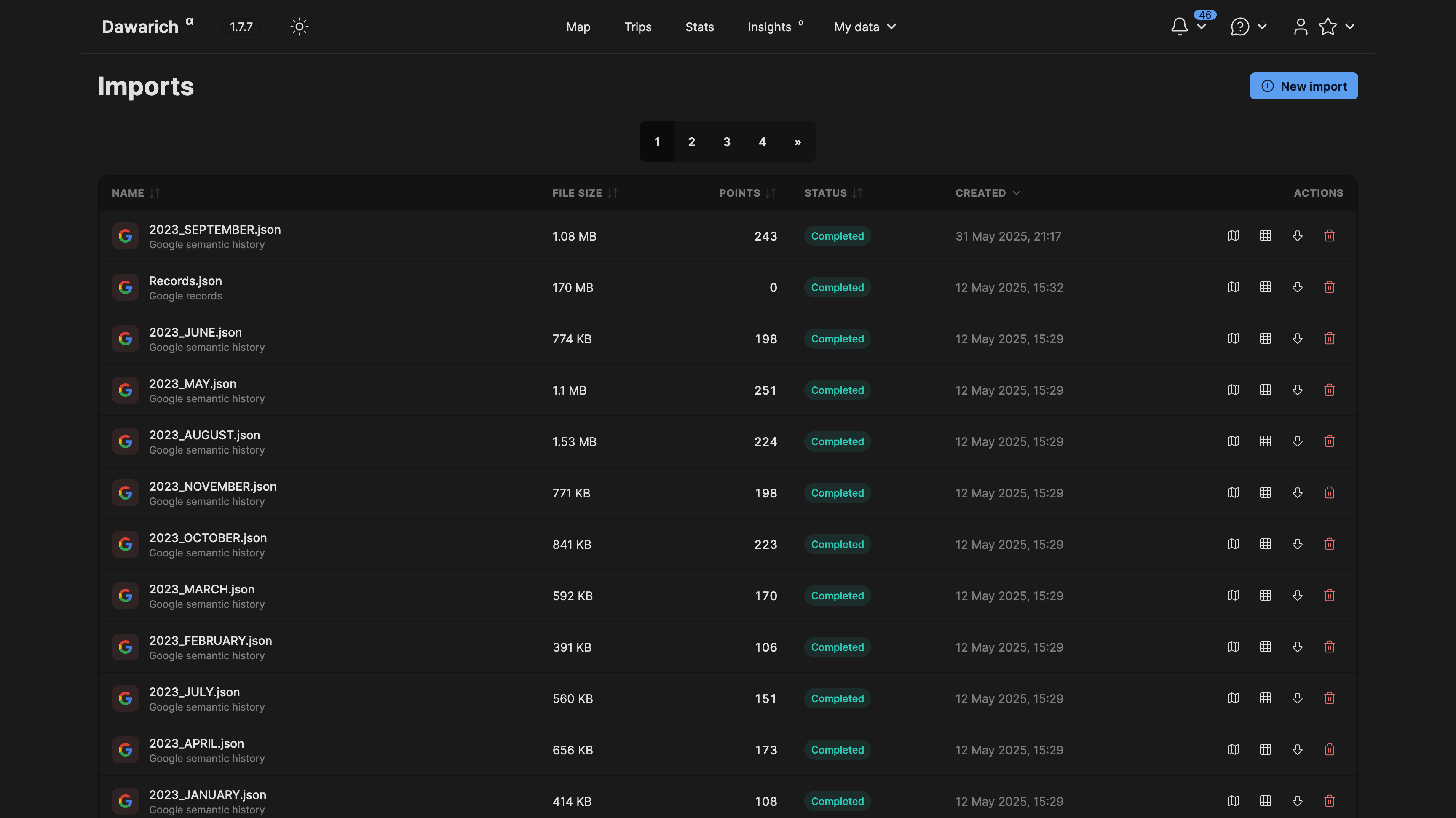
The Imports page displays all your data imports including the number of points imported and timestamp. You can manage individual imports and create new ones.
Viewing Imports
For each import, you can see:
- Import name (typically the filename)
- Number of points imported
- Import timestamp
- Processing status
Click on an import to view its details.
Deleting Imports
On an import's detail page, you can delete the import.
Deleting an import will delete all points that were imported from that file. This action cannot be undone.
Supported File Formats
Dawarich supports importing from various sources:
Google Timeline
- Records.json - The newer format from Google Takeout
- Location History.json - The older format from Google Takeout
- Semantic Location History - Activity and place visit data
GPS Exchange Format
- GPX - Standard GPS exchange format
- Supports tracks, routes, and waypoints
GeoJSON
- GeoJSON - Geographic data in JSON format
- Supports Point, LineString, and FeatureCollection
KML/KMZ (Google Earth)
- KML - Keyhole Markup Language files
- KMZ - Compressed KML archives
- Commonly exported from Google Earth and other mapping applications
OwnTracks
- OwnTracks .rec - Export from OwnTracks mobile app (.rec format only, JSON is not supported)
- Includes location history with metadata
Strava
- Strava exports - Activity data from Strava
- Supports both GPX and original format exports
Immich/Photoprism
- Import geodata from photos stored in your connected Immich or PhotoPrism instance
- Dawarich does not accept photo uploads directly — it fetches location data from these services
- See Photos for setup
Import Processing
When you import a file:
- The file is uploaded and queued for processing
- Points are extracted from the file format
- Duplicate points are automatically skipped
- If reverse geocoding is enabled, addresses are fetched
- You receive a notification when complete
Processing Time
- Most imports complete within minutes
- Large files (millions of points) may take hours
- Reverse geocoding adds significant time per point
Checking Status
Check the Sidekiq queue to monitor import progress:
- imports queue - File parsing
- default queue - Point processing and reverse geocoding
Duplicate Prevention
Points are validated for uniqueness using:
- Coordinates (latitude/longitude)
- Timestamp
This means:
- Importing the same file twice won't create duplicates
- Your tracking app sending the same point twice won't create duplicates
- Points with slightly different timestamps are treated as separate
Existing points will not be duplicated in the database neither with importing the same file twice nor with your client app writing a point twice. Within a user, a point is being validated for uniqueness by its coordinates and timestamp.
User Data Import
You can also import a full user data export from another Dawarich instance:
- Export your data from the source instance (Account Settings → Export My Data)
- On the new instance, go to Account Settings → Import My Data
- Upload the exported file
- All your points, settings, and metadata are imported
This is useful for:
- Migrating between instances
- Restoring from backup
- Merging accounts
Troubleshooting
Import seems stuck
If jobs are still in the "Enqueued" section after several hours:
- Check the
importsqueue - if empty, the import parsing completed - Check the
defaultqueue - points may be reverse geocoding - See Reverse Geocoding for rate limits
Import failed
Check the import details page for error messages. Common issues:
- Unsupported file format
- Malformed data
- Very large files timing out
Missing points after import
- Some file formats may not include all data types
- Points without valid timestamps are skipped
- Check if reverse geocoding is still processing
Creating New Imports
Click New Import on the Imports page to upload a file. For detailed instructions, see the Import Existing Data tutorial.